

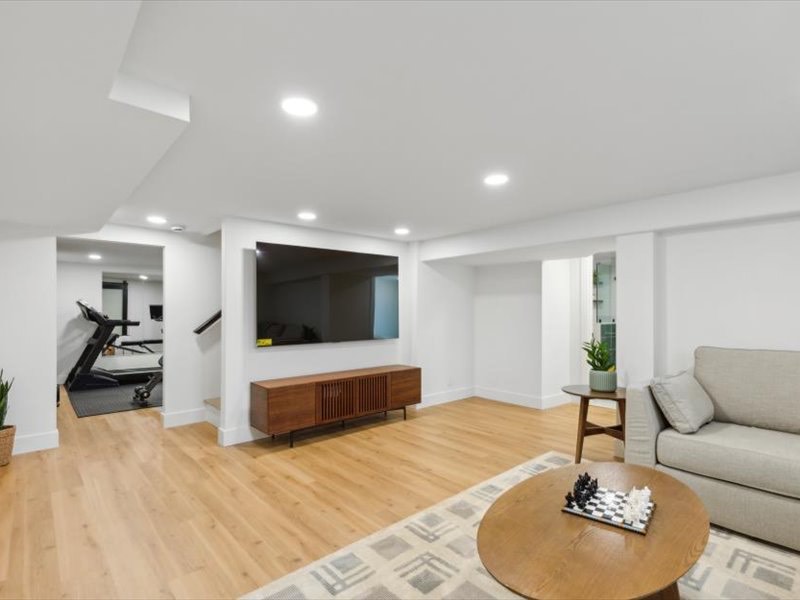
Waterproof laminate, rigid-core luxury vinyl, and porcelain tile all hold up in a damp basement, a bathroom, or a laundry room, and the differences between them come down to three things: what the core is made of, how the seams are sealed, and how much moisture is coming up through the slab underneath. The slab settles more Buffalo basement projects than the other two put together, and it's the part most people skip.
What Does Waterproof Actually Mean on a Flooring Spec Sheet?
Waterproof describes the plank or tile itself, and nothing below it. A waterproof core won't swell when water sits on the surface, which is the whole point in a laundry room where the washer eventually lets go. The seams are a separate question: water that works between planks, around the perimeter, or through grout reaches the subfloor, and the subfloor is where the expensive problems start. Floating floors also need an expansion gap at every wall, tucked under the baseboard, and that gap is a path. Water that finds it runs underneath the planks and sits there between the floor and the slab with nothing moving air across it, which is why a soaked floating floor gets pulled up and dried from below.
The industry has caught up to this. NALFA, the laminate trade group, certifies products against the ANSI/NALFA LF-01 standard across 14 performance categories, and moisture resistance is only one of them. It also offers a separate Surface Swell Test for an assembled joint, which measures whether a locked-together floor survives prolonged water exposure at the seam. A floor can pass the surface test and still fail at the joint, so the certification your product actually carries is worth asking about.
Is Waterproof Laminate Worth It in a Basement?
Waterproof laminate earns its place in kitchens, mudrooms, and powder rooms, and it's a reasonable basement floor when the slab tests dry. The core is high-density fiberboard, which is a wood product, so the waterproofing depends on a sealed surface, treated edges, and a tight locking system doing their jobs together. Spills wipe up fine. Standing water that sits for days is a different story, and that's the scenario a finished basement has to survive.
Two numbers on the spec sheet matter more than the marketing on the box. The AC rating covers surface wear: AC3 handles ordinary residential traffic, and AC4 or higher is the safer pick for a house with kids and a dog. The installation grade tells you whether the manufacturer approves the product below ground level, and that line rules out plenty of otherwise good laminate. In our catalog you can sort waterproof laminate and below-grade rated laminate separately, which makes that check quick.
Why Is Luxury Vinyl the Default Pick for Wet Rooms?
Rigid-core luxury vinyl skips the fiberboard core entirely, which is why it ends up in most basement and bathroom projects around here. SPC cores are stone-polymer composite. WPC cores mix wood flour into plastic and feel slightly softer underfoot. Both shrug off standing water without swelling. Many lines come with an attached pad, which takes the chill off a concrete slab and quiets a room that echoes.
Wear layer thickness, measured in mils, is the number to compare within a brand. A thicker wear layer handles dog nails and dragged furniture better, and the below-grade rating still has to be on the spec sheet before the product goes in a basement. Start with our waterproof luxury vinyl, and if the room is below ground, narrow to the planks rated for below-grade installation.
How Water Tolerant Is Porcelain Tile, Really?
Porcelain is the most water tolerant flooring you can buy, and the number behind that claim is specific. Under ANSI A137.1, tile only qualifies as porcelain when it absorbs 0.5% or less of its weight in water, measured by the ASTM C373 test. Ceramic tile absorbs more. Neither one swells, rots, or delaminates, which is why tile has owned bathrooms and entries for a century.
Grout is the weak spot, and it's worth understanding before you commit. Cement grout is porous, so it wicks water down to whatever sits below the tile, and the waterproofing in a real wet area comes from a membrane under the tile rather than from the tile itself. Tile is also the coldest surface in the house until you add radiant heat, and a dropped glass has no chance. In a finished basement family room, those trade-offs push a lot of people toward vinyl. In a laundry room with a floor drain, tile still wins.
Waterproof Laminate vs. LVP vs. Tile, Side by Side
All three are in our showrooms. The short version:
Comparison | Waterproof laminate | Rigid-core luxury vinyl | Porcelain tile |
|---|---|---|---|
Core material | High-density fiberboard, sealed | Stone-polymer (SPC) or wood-polymer (WPC) | Fired clay, 0.5% water absorption or less |
Standing water for days | Risky; depends on the joint seal | Handles it; dry the subfloor underneath | Handles it; grout and membrane do the work |
Below-grade use | Only if the spec sheet allows it | Common, with a below-grade rating | Yes, over a sound slab |
Feel underfoot | Firm, slightly warmer than tile | Warmer and quieter, especially with an attached pad | Cold and hard without radiant heat |
Subfloor prep | Flat, dry, floating install | Flat, dry, floating or glue-down | Flat, rigid, crack-isolation or waterproof membrane in wet areas |
Repairs | Replace planks from the wall in | Replace planks; glue-down repairs are spot fixes | Cut out and reset a tile; match grout color |
Best rooms | Kitchens, mudrooms, powder rooms | Basements, baths, laundry, whole floors | Full baths, entries, laundry with a drain |
How Do You Know If Your Concrete Slab Is Dry Enough?
You test it, and there are two standard ways. ASTM F2170 measures relative humidity inside the slab with a probe set at 40% of the slab's depth, sealed and left to equalize for at least 24 hours. ASTM F1869, the calcium chloride test, traps salt under a sealed dome for 60 to 72 hours and weighs how much moisture the slab gave off, reported in pounds per 1,000 square feet per 24 hours.
Limits vary by product, and the manufacturer's spec sheet is the one that governs the warranty. As a general range, resilient floors like LVP usually call for 75% to 80% in-situ relative humidity or a vapor emission rate of 3 to 5 pounds, wood wants 75% RH and under 3 pounds, and carpet tolerates up to 85% RH. Slabs poured decades ago often have no plastic vapor retarder underneath them, which is why an old basement deserves a test before anything goes down. Floating floors over concrete usually need a vapor retarder above the slab as well, either 6-mil poly or an underlayment with the film built in, and the installation instructions name which one. Skipping it is an easy way to lose a warranty claim.
Air matters as much as the slab. The EPA recommends keeping indoor humidity below 60%, ideally between 30% and 50%, and drying anything wet within 24 to 48 hours. A dehumidifier set in that range protects the floor you just bought and the boxes stored next to it.
Which Floor Belongs in Which Room?
Room | What usually goes down | Why |
|---|---|---|
Finished basement | Below-grade rated rigid-core LVP | Warmer than tile, and planks come out one at a time if the slab ever gets wet |
Full bathroom | Porcelain tile or LVP | Tile with a membrane for a tiled shower; LVP where budget and comfort lead |
Laundry room | Porcelain tile or LVP | A floor drain and a washer that can overflow favor tile |
Garage-entry mudroom | LVP or waterproof laminate | Salt, slush, and grit come in here first |
Kitchen | Waterproof laminate or LVP | Both take spills; softer underfoot than tile for long stretches of cooking |
Three-season room | Tile, or a floor rated for temperature swings | Unheated rooms fall outside most floating floor warranties |
What Makes Buffalo Basements Harder Than Most?
Basements here get hit from two directions, and the second one surprises people. Ground moisture pushes up through the slab and in at the walls, especially during a February thaw or a spring melt on saturated ground. Then July arrives, warm humid air pours down the stairs, and the moisture in it condenses on a slab still sitting at 60 degrees. That's the musty August smell in a house with no drainage problem at all.
Age compounds it. Census figures put roughly 64% of Buffalo's homes at pre-1940 construction, the oldest housing stock of any large American city, which means stone and block foundations and slabs poured long before vapor retarders were standard. Fix water entry before you spend money on flooring: grade, gutters, extensions, sump. A new floor over an active moisture problem buys you a season, and then the smell comes back.
Our article on waterproof basement flooring for lake-effect snow digs into the seasonal side of this, and the one on subfloor repairs in Western New York homes covers the warning signs worth checking before anything new goes down.
Which of These Floors Do We Stock at Kenny Carpets?
We stock all three. Laminate comes from Mannington, Mohawk, Shaw, and TRUCOR, and the catalog sorts it by AC rating, water protection, and installation grade. Luxury vinyl includes Mannington ADURA, COREtec, Mohawk, and TRUCOR, with waterproof and below-grade filters of its own. Tile is porcelain and ceramic from Daltile and American Olean.
Picking between them gets easier with samples in the room they're headed for, since basement lighting flattens color and makes everything read cooler than it does in a showroom. Stop by our Amherst, West Seneca, or Williamsville showrooms with your measurements, or let us bring samples to you through our shop-at-home service. Either way, the slab question comes first.
When you're ready for numbers, request a free in-home estimate. We'll measure the space, look at what's under the existing floor, talk through underlayment, old floor removal, and installation, and tell you straight which of the three belongs in your room.


