

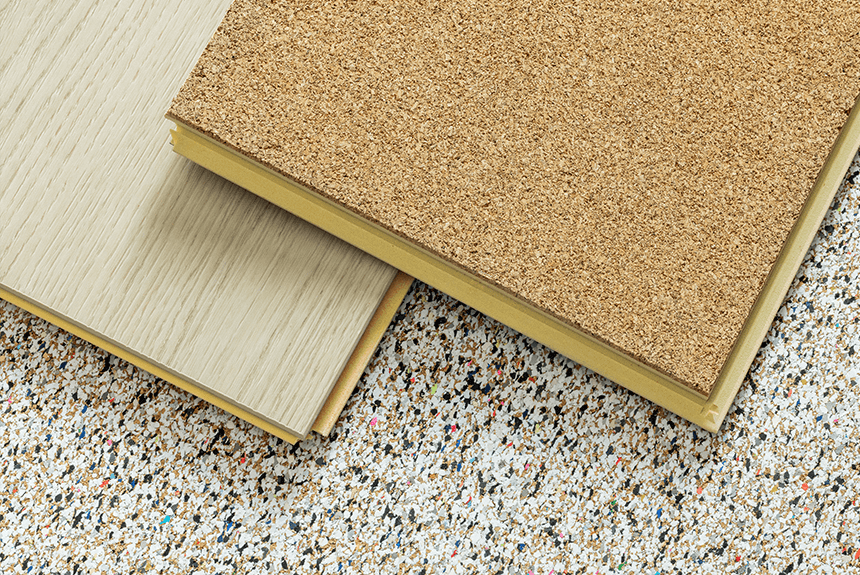
Cork flooring feels warmer underfoot than tile or vinyl, quiets the room below better than most hard surfaces, and asks for steady indoor humidity in return. Step onto a tile floor in a Buffalo kitchen in February and you know the difference in a second. Cork in that same room, thermostat untouched, reads warm. The reason sits in the material itself, and it's why we keep fielding questions about a floor most people around here have never walked on.
Why Does Cork Feel Warmer Than Tile or Vinyl?
Cork feels warm because it's mostly air. The Portuguese Cork Association (APCOR) counts about 40 million sealed cells in a single cubic centimeter of cork, and more than half of cork's volume is gas. Air conducts heat poorly, so a cork floor pulls warmth out of your bare foot much more slowly than ceramic tile or stone does. Your foot stays warm. Your brain reads the floor as warm, even though the thermostat hasn't moved.
Cork changes how a floor feels, not how much heat your house loses. R-value, the standard measure of how well a material blocks heat flow, swings widely for cork depending on density: thick expanded cork insulation board scores high, while the thin, dense cork in a floor plank scores much lower. A 6mm cork plank won't insulate a crawl space. If your floors run cold because there's no insulation under them, fix that first, then put cork on top for the comfort it adds.
How Much Footstep Noise Does Cork Actually Stop?
Cork cuts footstep noise enough to change how a two-story house sounds, and there's lab data behind that. Floors get graded on two scales: Impact Insulation Class (IIC) covers footsteps and dropped toys traveling down to the room below, and Sound Transmission Class (STC) covers airborne noise like voices and the TV. Higher is better on both. The International Building Code sets 50 as the minimum for floor assemblies between apartments or condo units, which makes 50 a useful yardstick even in a single-family house where no inspector is checking.
Jelinek Cork Group published test results that put numbers on what cork adds. A bare 6-inch concrete slab scored an IIC of 27, about as bad as it gets. Add 6mm of cork underlayment to that same slab and the score jumps to 50 for impact noise and 51 for airborne sound. Wicanders, the cork brand we carry, reports that its cork floors cut walking noise by up to 67% compared with a rigid floor. In the upper flat of a Buffalo double, that's the difference between hearing every step overhead and barely noticing anyone's home.
What Is Cork, and How Is It Harvested Without Cutting the Tree?
Cork is the outer bark of the cork oak, and stripping it leaves the tree standing. APCOR's rules are strict: a tree can't be harvested until its trunk measures 70cm around at chest height, which takes roughly 25 years, and after that the bark comes off once every nine years at most. Portugal enforces that interval by law and produces about 46% of the world's cork, off trees that keep producing for generations. What cork is made of explains how it behaves underfoot, too. Roughly 45% of it is suberin, a waxy natural compound that shrugs off water and gives cork its spring.
Those sealed cells squash to about half their thickness and bounce back. That's why a chair-leg dent in a cork floor usually fades within a few days, while the same dent in vinyl is there for good.
How Does Cork Compare With Carpet, Luxury Vinyl, and Tile?
We sell all four of these floors, and each one wins different rooms in a Western New York house.
Floor | Feel underfoot in winter | Footstep noise | Water tolerance | Dents and wear | Where it fits best |
|---|---|---|---|---|---|
Cork | Warm and slightly soft; the air in the cells slows heat loss from your feet | Very good; measurably cuts impact noise to rooms below | Good on standard planks, waterproof on cork-core Hydro planks; never for saunas or constantly wet rooms | Furniture dents usually recover; sunlight can fade the surface over years | Bedrooms, home offices, upper flats, kitchens, playrooms |
Carpet with pad | Warmest option, especially over a cold slab | Best in class for impact noise | Poor in wet areas; needs quick cleanup and a dry room | Shows traffic lanes over time; pad quality drives lifespan | Bedrooms, basements that stay dry, stairs, family rooms |
Luxury vinyl (rigid core) | Cooler than cork, warmer than tile; an attached pad helps | Good with the right underlayment | Waterproof lines handle mudrooms, baths, and laundry | Very scratch resistant; can't be refinished | Mudrooms, kitchens, baths, basements, rentals |
Ceramic or porcelain tile | Coldest underfoot unless you add radiant heat | Poorest; carries footsteps and echoes | The most water tolerant surface in the house | Extremely hard wearing; grout needs upkeep | Bathrooms, entries, laundry, anywhere water pools |
If comfort and quiet are what you're after, the real contest is between cork and carpet. If water is the deciding factor, put cork up against luxury vinyl.
Where Does Cork Work in a Buffalo-Area Home?
Cork does its best work in rooms where you stand, sleep, or want quiet. Kitchens come up first, since the give underfoot is easier on your legs through a long cooking session. Bedrooms and home offices come next for the sound control, and playrooms get a surface softer on knees than tile. Upper flats are the obvious one: if you own a double and you've ever listened to someone else's Saturday morning come down through the ceiling, those IIC numbers are describing your house.
Older houses need one extra check before cork goes down. Census figures put roughly 64% of Buffalo's homes at pre-1940 construction, the oldest housing stock of any large American city, and century-old floors settle. Glue-down cork tile telegraphs every dip and hump in the subfloor underneath it, so flatness gets measured before anything gets glued down. Floating cork planks are more forgiving, within the flatness tolerance the manufacturer publishes.
Cork has hard limits as well. Wicanders builds these floors for indoor use and rules out saunas and rooms that stay wet, so a full bathroom or a basement with a damp slab needs the waterproof cork-core planks. Any below-grade job starts with a moisture check on the slab. Unheated three-season rooms are out, because cork wants a steady indoor climate all year.
What Does a Cork Floor Ask of You in a Western New York Winter?
A cork floor asks for steady humidity more than anything else. Wicanders calls for a room between 65 and 82°F and relative humidity between 35% and 65%. Relative humidity is how much moisture the air holds compared with the most it could hold at that temperature, and ours crashes every winter for a simple reason: cold outdoor air carries very little water, and once it's heated to 70°F that same small amount has to fill air that can hold much more. Run a furnace for months and indoor air routinely sits below the 35% mark Wicanders wants. Cork shrinks a little as it dries out, so a cheap hygrometer on the wall and a humidifier through January keep the seams tight.
The rest is housekeeping, and Buffalo's weather decides most of it. We average 95.4 inches of snow a season across roughly 59 days with measurable snowfall, and the salt and grit riding in on boots wear a finish faster than foot traffic ever will. Mats at every door. Sweep or vacuum regularly, damp mop with a pH-neutral cleaner, and skip ammonia and abrasives, which Wicanders warns against. Felt pads under furniture legs help, and so do blinds or a rug in any room that takes hours of direct sun, since cork lightens with long UV exposure.
What a cork floor needs | The number |
|---|---|
Room temperature | 65 to 82°F |
Relative humidity, year round | 35% to 65% |
Subfloor surface temperature over radiant heat | 82°F (28°C) maximum |
Rooms to avoid | Saunas, constantly wet rooms, unheated three-season rooms |
Cleaning | pH-neutral cleaner; no ammonia, no abrasives |
Those figures come from Wicanders, the brand we stock. Other cork makers publish their own, so read the spec sheet for whatever floor you end up choosing.
Can Cork Go Over Radiant Heat?
Cork works over radiant heat, with one number to respect: Wicanders caps the subfloor surface temperature under its cork at 28°C, or 82°F. Push past that and you bake moisture out of the planks, which opens gaps at the seams. Bring the heat up gradually when the season starts, and hold the room humidity in that 35% to 65% window while you do. The pairing suits the material, since cork holds its warmth after the system cycles off, so the water or cable underneath never has to run hot for the room to feel comfortable.
How Long Does a Cork Floor Last, and What Drives the Price?
How long a cork floor lasts depends on which construction you buy. Glue-down cork tiles with a solid cork wear surface can often be screened and refinished, which resets the look years down the road. Floating cork planks with a printed or veneered top layer can't be refinished, so when the surface finally wears through, you replace planks. Both hold up a long time in a normal household, and both take everyday dents better than most hard surfaces do.
Price comes down to a handful of things worth asking about early: plank construction and thickness, standard cork floor or waterproof cork-core plank, what shape your subfloor is in, whether an old floor has to come up first, and the square footage and layout of the rooms. Furniture removal, old carpet disposal, underlayment, and residential installation land on the same quote.
Which Cork Floors Do We Stock at Kenny Carpets?
The cork we stock comes from Wicanders, the flooring arm of Portuguese cork producer Amorim. Cork Essence and Cork Inspire show cork's own grain. Wood Inspire, Wood Hydronatural, Wood Hydronatural XL, and Stone Hydronatural put wood and stone visuals over a cork core, and the Hydro planks are the ones built on a waterproof composite core, which is what gets cork into rooms a standard cork floor can't handle.
Air quality comes up with any manufactured floor, so here's what Wicanders publishes for its cork: GREENGUARD and TUV certifications for indoor air quality, plus an A+ rating on France's emissions label, the top of that scale. Those programs measure how much chemical vapor a floor gives off into a room after it's installed, which matters most in a house that stays shut from November through March. Our earlier article on the hidden benefits of cork flooring covers the material more broadly.
Cork is a floor you should feel before you commit. Walk on samples at our Amherst, West Seneca, or Williamsville showrooms, or have us bring them to you with our shop-at-home service so you can see the color next to your own cabinets and trim. When you want real numbers for a real room, request a free in-home estimate and we'll measure, look at what's under your existing floor, and tell you straight whether cork belongs there.


